
Can You Really Learn CPR From a Screen? What a Nationally Recognised First Aid Course Actually Involves

You have probably seen them. Facebook ads, Google results, Instagram stories – all promising a first aid certificate you can finish tonight from your couch. No classroom. No manikin. No trainer watching your technique. Just click through some slides, answer a quiz, and a certificate lands in your inbox. Sounds easy. But here is the question nobody selling those courses wants you to ask: is that certificate actually worth anything?
If you are searching for a first aid course in Tarneit or anywhere in Melbourne’s west, the answer matters more than you think. Because not every certificate that says “first aid” on it is a nationally recognised qualification.
The online first aid course industry has exploded. But most of it is not nationally recognised.
There is a real difference between a “certificate of completion” and a nationally recognised Statement of Attainment, and it comes down to three things:
- Who issued it. A nationally recognised qualification must come from a Registered Training Organisation (RTO) regulated by the Australian Skills Quality Authority (ASQA). If the provider does not have an RTO number, the certificate is not nationally recognised.
- What unit codes appear on it. Legitimate first aid certificates carry specific HLTAID unit codes: HLTAID009 for CPR, HLTAID011 for Provide First Aid, or HLTAID012 for Childcare First Aid. If your certificate says “General First Aid” with no unit code, it is not the qualification employers and regulators require.
- How you were assessed. Every HLTAID unit requires a face-to-face practical assessment. This is a training package requirement set at the national level. No RTO can waive it, no matter what their marketing says.
The practical assessment is not optional – and here is why that matters
CPR is a physical skill. The Australian Resuscitation Council guidelines require chest compressions at a depth of 5 to 6 centimetres on an adult, delivered at a rate of 100 to 120 compressions per minute, with correct hand placement on the lower half of the sternum. That is a specific, measurable standard. A screen cannot tell you whether you are hitting it.
In a face-to-face assessment, a qualified trainer watches your technique in real time. They check your hand placement, your compression depth, your rate, your arm position, your rescue breaths. They give you feedback you can feel. That feedback loop – doing it, getting corrected, doing it again – is what builds the muscle memory that matters when someone actually collapses in front of you.
The numbers back this up. Ambulance Victoria’s 2024-25 data shows that 63 per cent of cardiac arrest patients survived when a bystander used an AED before paramedics arrived, compared to just seven per cent when there was no bystander CPR or defibrillation at all (Ambulance Victoria, 2025). Those bystanders did not learn their skills from a quiz. They practised on manikins, got trainer feedback, and built the confidence to act.
What actually happens in a face-to-face first aid course (step by step)
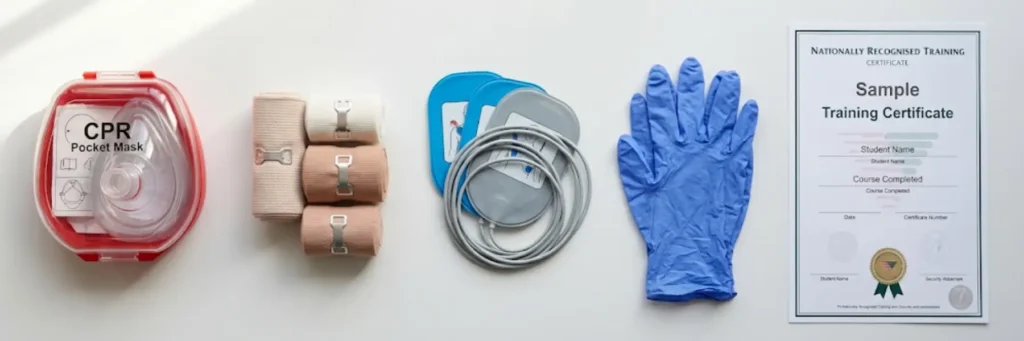
If you have never done an accredited first aid course before, here is what to expect at SafeHands First Aid Academy:
- Book your course online. Choose HLTAID009, HLTAID011, or HLTAID012 depending on what you need. Not sure which? The FAQ page breaks it down.
- Complete the online theory. You will receive login details for the pre-learning module. This covers the knowledge component – DRSABCD, legal considerations, duty of care, types of injuries and illnesses. You work through this at your own pace before your practical session.
- Arrive at the training venue. SafeHands runs courses at the Tarneit Community Learning Centre, 150 Sunset Views Blvd, Tarneit.
- Hands-on CPR practice. You practise chest compressions and rescue breaths on advanced CPR manikins that give visual feedback on compression depth and rate.
- First aid scenario practice. For HLTAID011 and HLTAID012, you work through realistic scenarios: bleeding control, burns management, fracture response, asthma and anaphylaxis emergencies.
- Formal practical assessment. The trainer assesses your CPR technique and first aid responses against the national competency standards.
- Same-day certificate. If you are assessed as competent and have completed all online and practical requirements, your nationally recognised Statement of Attainment is available the same day.
The whole practical session runs about 45 minutes for CPR (HLTAID009) or around two hours for the full first aid course (HLTAID011). You can read more about what each course covers on the CPR and First Aid Courses page.
What the assessor is actually looking for during your practical
It is not a pass-fail exam in the traditional sense. The assessor is checking that you can demonstrate specific skills competently:
- DRSABCD sequence: Can you work through Danger, Response, Send for help, Airway, Breathing, CPR, Defibrillation in the correct order without prompting?
- CPR technique: Correct hand placement, adequate depth (5-6 cm), correct rate (100-120/min), full chest recoil between compressions, effective rescue breaths.
- Confidence under pressure: Can you manage a simulated emergency calmly, delegate tasks, and communicate clearly?
- Safe response: Do you check for danger before approaching? Do you use appropriate PPE?
Nobody expects perfection. What they are looking for is competence, safe practice, and the ability to follow a structured response. The trainers at SafeHands are registered nurses with real healthcare experience, so they know what effective emergency response actually looks like.
Face-to-face first aid training in Tarneit (every Saturday)
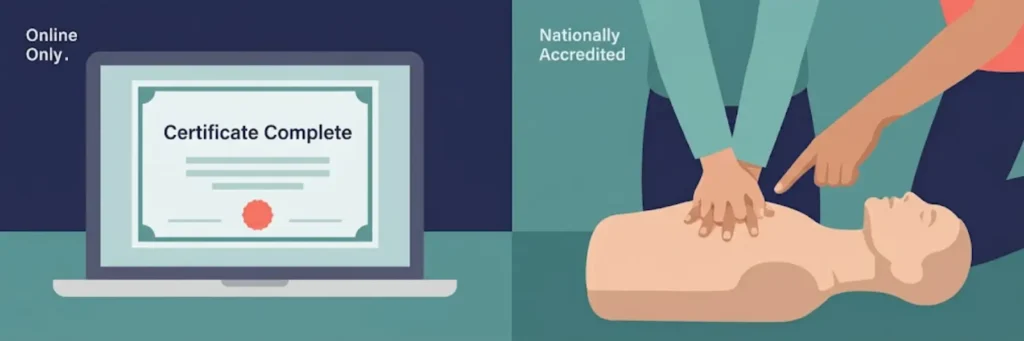
SafeHands First Aid Academy runs accredited first aid and CPR courses at the Tarneit Community Learning Centre, 150 Sunset Views Blvd, Tarneit VIC 3029. Here is a quick look at what is available:
- HLTAID009 – CPR: $45. Online theory + approx. 45 minutes practical. Annual renewal.
- HLTAID011 – Provide First Aid (includes CPR): $79. Online theory + approx. 2 hours practical. Valid 3 years (CPR component renewed annually).
- HLTAID012 – Childcare First Aid (includes CPR): $109. Online theory + approx. 2 hours practical. Required for childcare, OSHC, and early learning workers.
All courses are delivered on behalf of Allens Training Pty Ltd (RTO 90909), an ASQA-regulated Registered Training Organisation. Training is led by registered nurse instructors. Same-day certificates are available after successful completion.
The venue serves learners from across the Wyndham growth corridor, including Tarneit, Werribee, Truganina, Hoppers Crossing, Wyndham Vale, and Point Cook. Free parking is available, and Tarneit Train Station is nearby.
Ready to book? Reserve your spot here or contact us if you have questions.
Why the Tarneit Community Learning Centre works for western suburbs residents
Tarneit sits right in the middle of Melbourne’s fastest-growing corridor. The community learning centre is purpose-built for training delivery, with ample room for practical exercises. If you live anywhere in the City of Wyndham, this is likely the closest accredited face-to-face first aid training option with weekend availability. No need to drive into the CBD or across town on a Saturday morning.
So when is an online first aid course actually useful?
To be fair, online learning has a genuine role in first aid education. It works well for:
- General awareness. If you want a basic understanding of first aid concepts for personal knowledge, an online course can cover that.
- Pre-course preparation. The blended model – online theory followed by face-to-face practical – is how most accredited providers structure their training now. The online component saves classroom time and lets you learn the theory at your own pace.
- Workplace toolbox talks. Short online refreshers can help keep first aid front of mind between formal renewals.
But if your employer, university, regulatory body, or insurer requires a “nationally recognised” first aid qualification, online-only will not meet that standard. The HLTAID training package is clear: practical assessment must be face-to-face.
The blended model is the best of both worlds. You get the convenience of online theory and the hands-on practice that actually builds skill and confidence. That is exactly how SafeHands structures every course. If you want to understand why hands-on CPR practice matters, there is a deeper read on the SafeHands blog.
5 things to check before booking any first aid course
Before you hand over your money, run through this checklist:
- RTO number. Can you find the provider on training.gov.au? If not, walk away.
- Unit code on the certificate. Make sure it says HLTAID009, HLTAID011, or HLTAID012 – not just “first aid certificate.”
- Practical assessment included? If there is no face-to-face component, the qualification will not be nationally recognised.
- Instructor qualifications. Are the trainers qualified and experienced? SafeHands courses are led by registered nurses who bring real clinical and emergency response experience to every session. Learn more on the About Us page.
- Certificate turnaround time. Legitimate providers like SafeHands issue same-day certificates after successful completion. Be cautious of providers who take weeks to issue or charge extra for the certificate itself.
If you have been putting off your first aid training or are due for a renewal, there is no better time to get it sorted. Book your course with SafeHands First Aid Academy and walk away with a nationally recognised qualification, practical skills, and the confidence to act when it matters. If you want to read more about staying calm in an emergency or the top five first aid skills everyone should know, the SafeHands blog has you covered.
Frequently asked questions
Can I get a same-day first aid certificate online?
You can get a same-day completion certificate from some online providers, but it will not be a nationally recognised Statement of Attainment. Nationally recognised first aid qualifications require a face-to-face practical assessment.
What if my employer accepted an online certificate last year?
Some employers may not have checked the accreditation status. If a SafeWork inspector audits your workplace, an online-only certificate may not meet compliance requirements under the WHS Code of Practice for First Aid in the Workplace.
How do I check if a provider is a real RTO?
Search the provider’s name or RTO number on training.gov.au. If they are not listed, the training is not nationally recognised.
Why does CPR need hands-on practice?
CPR requires compressions at 5-6 cm depth and 100-120 compressions per minute on an adult. That is a physical standard you can only learn, practise, and be assessed on with a manikin and a qualified trainer watching your technique.
Is online pre-learning the same as online-only?
No. Online pre-learning is the theory component of a blended course – you complete it before attending a face-to-face practical session. Online-only means no practical assessment at all, which means no nationally recognised qualification.
For more common questions, visit the SafeHands FAQ page.