
BLS for Nurses: The CPR and Life Support Skills Every Clinical Role Needs

Every nurse remembers the first time someone asked to see a current CPR certificate. Maybe it was during placement. Maybe it was a new employer’s HR department. Maybe it was the morning of an agency shift when the ward manager asked for proof before handing over a lanyard. Wherever it happened, the question was the same: is your BLS course current?
The answer matters. Most clinical roles in Australia require a current basic life support certificate, and the certificate most employers and placement providers accept maps to two nationally recognised units: HLTAID009 (Provide Cardiopulmonary Resuscitation) and HLTAID010 (Provide Basic Emergency Life Support). This guide explains what those units cover, how long they last, what the practical session involves and when to renew.
What BLS means in Australia
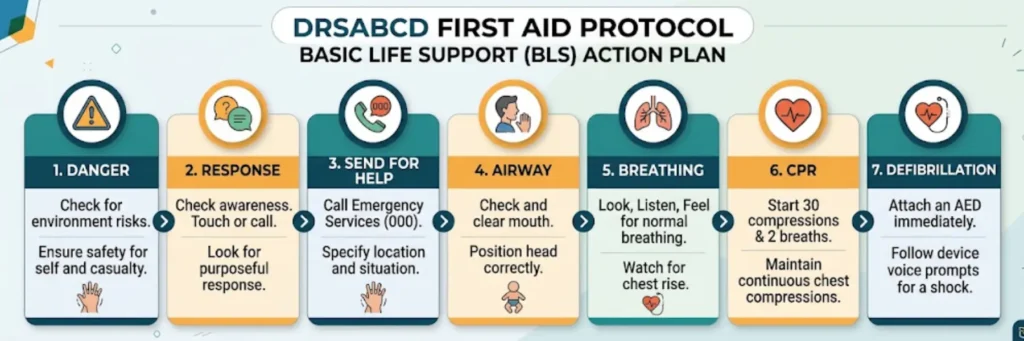
Basic life support is the set of skills used in the first minutes of a cardiac or respiratory emergency. It is not a single course name. It is a level of clinical response that sits between calling 000 and the arrival of advanced medical intervention.
In practical terms, BLS covers:
- DRSABCD: Danger, Response, Send for help, Airway, Breathing, CPR, Defibrillation. This is the structured action plan taught across all Australian resuscitation training and endorsed by the Australian Resuscitation Council.
- CPR: Chest compressions and rescue breathing on adults, performed to current guidelines (100 to 120 compressions per minute, adequate depth, full chest recoil).
- AED use: Applying and operating an automated external defibrillator safely.
- Recovery position: Placing an unconscious, breathing casualty on their side to maintain an open airway.
- Choking response: Recognising and managing an obstructed airway.
These are not theoretical concepts for nurses. They are practical skills you may need to use on any shift, in any setting, and the expectation is that you can perform them confidently and without hesitation.
Victoria’s cardiac arrest survival data reinforces why this matters. In 2024-25, Ambulance Victoria’s internationally comparable witnessed survival rate reached 44.4%, the highest in the country and the second highest in the world. Eighty per cent of witnessed cardiac arrests received bystander CPR before paramedics arrived (Ambulance Victoria VACAR Annual Report 2024-25, March 2026). Early CPR and defibrillation are the difference, and for nurses, maintaining those skills is not optional.
Which unit maps to a “BLS course”
This is the question that causes the most confusion. A “BLS course” is not a single unit code. In Australia’s nationally recognised training framework, the skills are delivered through two units:
- HLTAID009 Provide Cardiopulmonary Resuscitation (CPR). This is the core CPR unit. It covers adult CPR, AED use, the DRSABCD action plan and rescue breathing. It is the unit you renew every 12 months.
- HLTAID010 Provide Basic Emergency Life Support. This builds on HLTAID009 and is the closest community-training match to what most clinical settings call “BLS.” It includes HLTAID009 within it, plus additional content on managing an unconscious casualty, choking response and basic emergency life support procedures.
For most nurses renewing annually, the HLTAID009 CPR course is the unit that keeps the certificate current. If you need the broader BLS-level qualification, the HLTAID010 course covers both.
It is worth noting that SafeHands First Aid Academy does not hold RACGP CPD accreditation. If your employer or registration body requires a CPD-accredited BLS course specifically, confirm their requirements before booking. For most nursing roles, a current Statement of Attainment in HLTAID009 or HLTAID010 from a Registered Training Organisation is what employers and placement providers accept.
How long the certificate lasts
- HLTAID009 (CPR): Refreshed every 12 months.
- HLTAID010 (Basic Emergency Life Support): Valid for 3 years, with the CPR component (HLTAID009) refreshed annually within that period.
The 12-month CPR cycle is not arbitrary. ANZCOR Guideline 10.1 on Basic Life Support Training notes that skills deteriorate after standard training, and recommends more frequent manikin-based refresher training to maintain competence compared with standard retraining intervals of 12 to 24 months. ANZCOR specifically notes that the rapid decay in skills after BLS training is a concern for patient care.
This is why employers and placement providers check the date, not just the certificate. A Statement of Attainment issued 14 months ago may still technically exist, but your CPR is no longer considered current. For agency nurses and those on clinical placement, a lapsed CPR date can mean losing a shift or delaying a placement start.
What the practical session covers
Both HLTAID009 and HLTAID010 are delivered as blended learning:
- Online pre-learning completed independently before your practical session. This covers the theory: the physiology of cardiac arrest, legal considerations, infection control and the DRSABCD framework.
- Face-to-face practical assessment where you demonstrate hands-on skills with a qualified trainer.
During the practical, you will:
- Perform CPR on an adult manikin for a minimum of two minutes (compressions and rescue breathing)
- Demonstrate correct AED pad placement and operation
- Place a casualty in the recovery position
- Work through the full DRSABCD sequence in a simulated scenario
- Receive direct feedback from your trainer on technique
On successful completion, you receive a same-day Statement of Attainment. No waiting for the post.
Our blog on the importance of CPR training covers why hands-on practice matters more than theory alone, and our piece on what a nationally accredited course actually involves explains the difference between watching a video and building genuine muscle memory.
How BLS differs from a full first aid course
BLS-level training (HLTAID009 and HLTAID010) focuses specifically on life support: CPR, AED use, airway management and the immediate response to a cardiac or respiratory emergency.
A full first aid course, HLTAID011 Provide First Aid, adds a broader scope of emergency response:
- Bleeding control and wound management
- Burns treatment
- Fracture and sprain management
- Anaphylaxis recognition and adrenaline autoinjector use
- Asthma management
- Envenomation (snake and spider bites)
- Shock, seizures and medical emergencies
Nurses who need only the life-support component for annual renewal can stay on HLTAID009 or HLTAID010. Those in supervisory roles, high-risk workplaces or settings that require a broader first aid certificate often hold HLTAID011 as well.
If you are unsure which course your employer requires, check before you book. The unit code on the Statement of Attainment is what matters.
Why the skills decay and the renewal matters
CPR is a physical skill. Like any physical skill, it fades without practice. Research consistently shows that resuscitation skills begin to deteriorate within weeks to months after initial training, well before the formal certificate validity expires.
This is not about paperwork. It is about whether you can perform effective chest compressions at the right depth and rate, manage an AED without hesitation, and work through DRSABCD under pressure. Annual retraining resets that muscle memory.
For nurses specifically, the renewal cycle also aligns with employer expectations. Most hospitals, aged care facilities, NDIS providers and nursing agencies require evidence of a CPR certificate issued within the previous 12 months. The date on the certificate is the first thing checked during onboarding, placement and compliance audits.
Where nurses can renew in Melbourne’s west
SafeHands First Aid Academy delivers HLTAID010 Provide Basic Emergency Life Support and HLTAID009 CPR with nurse-led trainers and same-day certificates. Training and assessment is delivered on behalf of Allens Training Pty Ltd RTO 90909.
The course pages carry the current schedule and booking details. We run practical sessions across Melbourne’s western suburbs, including Truganina, Tarneit, Werribee and Hoppers Crossing.
If you need to renew before your next shift or placement, book your HLTAID009 renewal here.
5 checks before you renew
- Find your current certificate and read the issue date. If it was issued more than 12 months ago, your CPR is overdue.
- Confirm which unit your employer or placement requires. Most accept HLTAID009 for annual CPR renewal. Some require HLTAID010 or HLTAID011. Ask before you book.
- Book at month 11, not month 13. Do not wait until your certificate has lapsed. A gap in currency can delay shifts or placement starts.
- Complete the online theory before the practical. The pre-learning must be finished before you attend the face-to-face session. Allow time for this.
- Carry a digital copy on your phone. Your Statement of Attainment will be emailed. Save it where you can access it quickly at onboarding or on the ward.
Frequently asked questions
What are the 7 steps of BLS?
The standard BLS response in Australia follows the DRSABCD action plan: Danger, Response, Send for help, Airway, Breathing, CPR, Defibrillation. These seven steps form the backbone of every BLS course and are the sequence you practise in the face-to-face practical.
How long is a BLS certificate valid in Australia?
HLTAID010 (Basic Emergency Life Support) is valid for three years. The CPR component (HLTAID009) must be renewed every 12 months within that period. For most nursing roles, the annual CPR renewal is the critical date.
Can I do my BLS or CPR course entirely online?
No. The theory component is completed online, but the practical assessment must be completed face-to-face. You need to demonstrate CPR on a manikin and show competency in AED use with a qualified assessor present. ANZCOR recommends a blended learning approach that includes a face-to-face component for life support training.
Is HLTAID010 the same as BLS?
HLTAID010 Provide Basic Emergency Life Support is the nationally recognised unit that most closely matches what clinical settings call a “BLS course.” It includes HLTAID009 (CPR) within it. The unit covers CPR, AED use, airway management, recovery position and the DRSABCD action plan.
Do nurses need HLTAID011 too?
It depends on the role. HLTAID011 (Provide First Aid) is a broader qualification that adds wound care, burns, fractures, anaphylaxis and other medical emergencies beyond life support. Some employers and supervisory roles require it. For annual CPR renewal alone, HLTAID009 is sufficient.
Need to renew your CPR before your next shift? Visit the HLTAID009 course page for the current schedule, or book your renewal directly.