
Childcare First Aid: The Complete Guide for Early Childhood Educators

Walk into any childcare centre in Australia and ask what first aid certificate you need. You will probably hear three different answers. One person says HLTAID011. Another says HLTAID012. A third just says “the childcare one.” The confusion is real, and it matters, because childcare first aid is not a general workplace certificate with a different name. It is a specific nationally recognised qualification, HLTAID012, designed for the education and care sector. It lasts three years, the CPR component needs refreshing every 12 months, and getting the wrong one can leave you or your centre out of compliance from day one.
This guide breaks it down clearly: what the qualification covers, who actually needs it, how long it lasts, what happens in the practical session, and what to check before you book.
What “childcare first aid” actually means
When people search for a first aid course for childcare, the unit they need is HLTAID012 Provide First Aid in an education and care setting. It is the nationally recognised qualification for anyone working in a regulated education and care service in Australia.
HLTAID012 is endorsed by ACECQA (the Australian Children’s Education and Care Quality Authority) as satisfying all three training requirements for education and care staff in a single course:
- Approved first aid qualification
- Approved anaphylaxis management training
- Approved emergency asthma management training
The course itself covers:
- Adult, child and infant CPR
- The DRSABCD action plan
- Anaphylaxis recognition and adrenaline autoinjector (EpiPen) use
- Asthma management and spacer device use
- Choking response for infants and children
- Seizure management
- Bleeding, burns, fractures, shock
- Emergency response specific to education and care settings
- Incident reporting to emergency services, parents, caregivers and regulatory authorities
This is more than a standard workplace first aid course. HLTAID012 includes child and infant specific scenarios that a general HLTAID011 certificate does not cover to the same depth.
Who needs HLTAID012 and who can stay on HLTAID011
Not everyone needs the education and care version. Here is the straightforward split:
You need HLTAID012 if you are:
- An early childhood educator in a long day care, preschool or kindergarten
- An OSHC (Outside School Hours Care) worker
- A family day care educator
- School support staff working in a regulated education and care service
- A nominated supervisor or responsible person under the National Quality Framework
HLTAID011 is sufficient if you are:
- A parent or carer doing the course for personal confidence
- A standard workplace employee (office, retail, hospitality, construction)
- A volunteer in a setting that is not a regulated education and care service
- A student who needs a general first aid certificate for placement in a non-childcare setting
The key distinction is “regulated education and care service.” If your workplace falls under the Education and Care Services National Law, HLTAID012 is the requirement.
How long the certificate lasts and the 12-month CPR rule
This is where most compliance issues quietly start.
Your HLTAID012 certificate is valid for three years from the date of issue. But the CPR component (HLTAID009) must be renewed every 12 months. That annual CPR renewal has been a requirement under the national regulations since 1 October 2023, and it is the part that catches people out.
Here is how it works in practice:
- You complete HLTAID012 in September 2026. Your full first aid certificate is valid until September 2029.
- Your CPR must be renewed by September 2027, then again by September 2028, then again when you redo the full course.
- If your CPR lapses, your centre is technically non-compliant, even though your HLTAID012 certificate still has time left on it.
This is not optional. ACECQA expects at least one educator with current first aid, anaphylaxis and asthma qualifications to be present whenever children are being educated and cared for. “Current” includes that annual CPR renewal.
SafeHands First Aid Academy delivers the HLTAID009 CPR refresher as a standalone course so you can keep your CPR current without redoing the full qualification each year.
What the practical session involves
The HLTAID012 course is delivered as blended learning:
- Online pre-learning completed independently before your practical session. This covers the theory: legal responsibilities, infection control principles, anatomy and physiology relevant to CPR, and the DRSABCD framework.
- Face-to-face practical assessment where you demonstrate hands-on skills under the guidance of a qualified trainer.
During the practical session, you will:
- Practise CPR on adult, child and infant manikins
- Work through anaphylaxis and asthma emergency scenarios
- Demonstrate choking response for infants and children
- Apply the DRSABCD action plan in simulated situations
- Manage wounds, bleeding and shock scenarios
- Complete incident reporting exercises
On successful completion, you receive a same-day Statement of Attainment for HLTAID012 issued by a Registered Training Organisation.
The course is practical and scenario-based. If you have read our blog on what a nationally accredited first aid course actually involves, you will know that hands-on practice is the core of the learning, not the online component.
For full course details and the current schedule, visit the SafeHands HLTAID012 course page.
What belongs in a childcare first aid kit
This is one of the most common questions we hear, and the honest answer is: your kit should reflect your service’s own risk assessment and regulatory expectations. ACECQA does not prescribe an exact list of contents, but the Australian Resuscitation Council and Safe Work Australia guidelines provide the standard benchmarks.
A well-stocked childcare first aid kit typically includes:
- Adhesive dressings (various sizes, including child-friendly options)
- Sterile wound dressings and non-stick pads
- Conforming bandages and triangular bandages
- Adhesive tape
- Disposable nitrile gloves (multiple pairs)
- CPR face shield or pocket mask
- Resuscitation chart (ARC guidelines)
- Saline solution for eye and wound irrigation
- Scissors, tweezers and safety pins
- An instant cold pack
- A current first aid reference guide
- Incident report forms
The HLTAID012 course teaches you how to use every item in that kit, not just how to stock one. Understanding when and how to apply a dressing, when to use a cold pack versus when to call 000, and how to manage a scene while keeping other children safe are all part of the training.
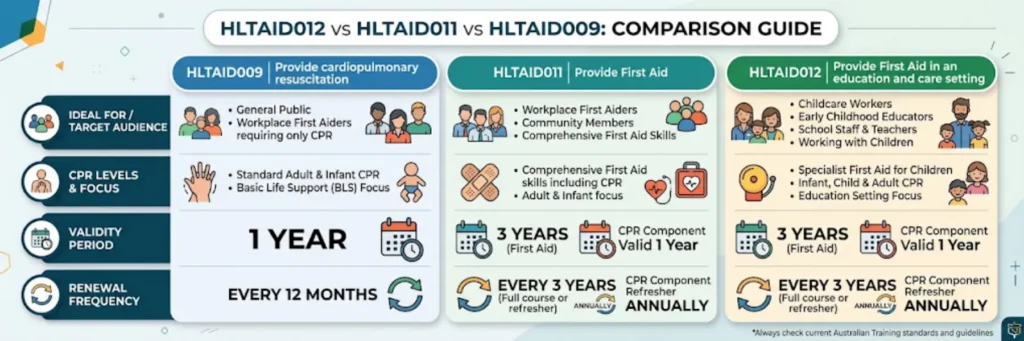
HLTAID012 vs HLTAID011 vs HLTAID009, in plain terms
These three unit codes come up repeatedly, and the differences matter.
| HLTAID009 | HLTAID011 | HLTAID012 | |
| Full name | Provide Cardiopulmonary Resuscitation | Provide First Aid | Provide First Aid in an Education and Care Setting |
| Best for | Annual CPR refresher | Workplace first aid (general) | Childcare, early learning, OSHC, school support |
| CPR levels | Adult CPR | Adult CPR | Adult, child and infant CPR |
| Anaphylaxis and asthma | No | Included but not ACECQA-endorsed on its own | Included and ACECQA-endorsed |
| Validity | 12 months | 3 years (CPR renewed annually) | 3 years (CPR renewed annually) |
| Meets childcare regulations? | No (CPR only) | Not on its own for regulated education and care services | Yes |
If you already hold HLTAID011 and work in childcare, check with your centre. In most cases, you will need to upgrade to HLTAID012 to satisfy all three ACECQA requirements in a single qualification. Our earlier blog, Which First Aid Course Do You Actually Need for a Childcare Job?, walks through the course-selection process in more detail.
Where to do your childcare first aid course
SafeHands First Aid Academy delivers the HLTAID012 Provide First Aid in an education and care setting course with nurse-led trainers and same-day certificates. Training and assessment is delivered on behalf of Allens Training Pty Ltd RTO 90909.
The course page carries the current schedule and booking details. We also offer group bookings for childcare centres, early learning services and OSHC providers. If you need training for a whole team, get in touch and we will work out a session that fits your roster.
We run face-to-face practical sessions in Melbourne’s western suburbs, including venues across Tarneit, Werribee, Truganina and Hoppers Crossing.
5 things to check before you book
- Confirm the unit is HLTAID012. Not HLTAID011. Not “childcare first aid” with no unit code attached. The Statement of Attainment must state HLTAID012.
- Check the CPR date on any existing certificate. If your CPR is more than 12 months old, you need a renewal regardless of when your full certificate expires.
- Confirm the provider is an RTO. SafeHands First Aid Academy delivers training and assessment on behalf of Allens Training Pty Ltd RTO 90909, a Registered Training Organisation regulated by the Australian Skills Quality Authority (ASQA).
- Check the venue and what to bring. Wear comfortable clothing you can kneel in. You will be practising CPR on the floor.
- Put the renewal dates in the calendar now. Book your CPR refresher for 12 months out and your full recertification for three years. Do not wait until your centre’s compliance audit reminds you.
Frequently asked questions
How long does a first aid certificate last in childcare?
The HLTAID012 certificate is valid for three years. The CPR component (HLTAID009) must be renewed every 12 months within that period.
Is HLTAID012 the same as HLTAID011?
No. HLTAID012 includes everything in HLTAID011 plus additional content specific to education and care settings, including child and infant CPR, and ACECQA-endorsed anaphylaxis and asthma management training.
Do I need to renew CPR every year even if my certificate is current for three years?
Yes. Since 1 October 2023, annual CPR renewal has been a requirement under the national regulations for education and care staff. Your full certificate may still be valid, but your CPR must remain current within the previous 12 months.
Can I do the course entirely online?
No. The theory component is completed online, but the practical assessment must be completed face-to-face. You need to demonstrate CPR, anaphylaxis response and other skills on manikins with a qualified assessor present.
Do I need a USI?
Yes. A Unique Student Identifier (USI) is required for all nationally recognised training in Australia. If you do not have one, you can create one for free at usi.gov.au before your course date.
Ready to get your childcare first aid sorted? Visit the HLTAID012 course page for the current schedule, or contact us about group bookings for your centre.